
How many tools should a ChatGPT app have?
69% of ChatGPT apps have five tools or fewer. We assumed most apps would ship a dozen or more to cover their product surface area. Instead, when we analyzed all 147 third-party apps in the ChatGPT App Store, we found the typical app is lean: the average is 6 tools per app, but the median is just 3.
We dug into the data to understand what drives those numbers and what they suggest about the right tool count for a new app.
Why We Excluded OpenAI's Own Integrations
OpenAI's App Store includes both third-party apps and integrations that OpenAI builds and maintains itself (like GitHub, Linear, Slack, and Google Workspace). We excluded OpenAI's built-in integrations because they aren't representative of what a typical developer ships. OpenAI has deep platform access and dedicated engineering teams for these connectors. A GitHub integration maintained by OpenAI with 61 tools tells you more about OpenAI's priorities than about what an independent developer should aim for. Focusing on third-party apps gives a cleaner picture of how teams are actually building for this platform.
The Full Distribution: Most Apps Stay Small
Across 147 third-party apps, there are 886 total tools. Here's how they break down:
| Tool Count | Apps | Share |
|---|---|---|
| 1-5 tools | 101 | 69% |
| 6-10 tools | 24 | 16% |
| 11-15 tools | 6 | 4% |
| 16-20 tools | 4 | 3% |
| 21+ tools | 12 | 8% |
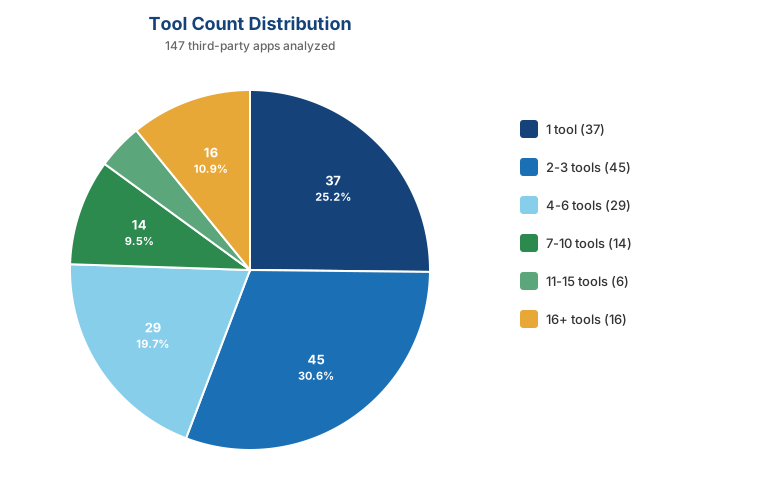
The distribution is heavily right-skewed. More than two-thirds of apps ship with 5 tools or fewer, and 85% have 10 or fewer. Only 12 apps (8%) cross the 21-tool mark. It follows a power-law pattern: a small number of apps carry a disproportionate share of total tools while the long tail stays minimal.
The "Missing Middle"
Only 6 apps (4%) land in the 11-15 tool range. You'd expect a gradual decline from the 1-5 bucket through the higher ranges, but instead there's a sharp drop-off after 10 tools, then a bump at 21+. Apps cluster into two camps: lean integrations focused on a handful of core actions, and full-platform connectors exposing 20+ operations. Very few teams land in between, which suggests that once you move past the "focused app" model, the logic of your product pulls you toward a much larger surface area.
The Top 10: Who's Shipping the Most Tools (and Why)
The apps at the top tend to be platforms with broad, complex APIs.
-
Gusto (40 tools, Finance): Tools like
run_payroll,list_employees, andcalculate_payrollreflect that HR and finance workflows have many discrete steps that are hard to collapse into a single action. -
Monday.com (35 tools, Productivity):
create_item,create_board,board_insights, andget_sprint_summaryspan a wide surface area of project management workflows. -
Canva (34 tools, Design):
generate-design,search-designs,autofill-design, andcomment-on-designcover the full lifecycle of design creation and editing. -
Atlassian Rovo (34 tools, Collaboration):
createJiraIssue,searchConfluenceUsingCql, andgetJiraIssuereflect how Atlassian bridges Jira and Confluence under one app. -
Retell AI (28 tools, Business): A voice AI platform exposing tooling across call management, agent configuration, and analytics.
-
Stripe (26 tools, Finance):
create_payment_link,list_charges, andlist_customersmap to the most common payment operations. Stripe's API is famously granular, and their ChatGPT app reflects that. -
Klaviyo (26 tools, Productivity): Email marketing automation involves campaigns, segments, templates, flows, and analytics, each needing its own set of operations.
-
Egnyte (23 tools, Collaboration): Cloud file management across sharing, permissions, folder structures, and search adds up quickly.
-
Cloudinary (23 tools, Developer Tools): Media management (upload, transform, organize, deliver) has enough distinct operations to justify a high count.
-
S&P Global (23 tools, Finance): Financial data services span market data, company fundamentals, and research, each requiring specialized query tools.
What the Top 10 Have in Common
These are all platforms, not single-purpose utilities. They have broad APIs, serve professional users who perform complex multi-step workflows, and build for developers or power users who expect granular control.
Finance apps are notably well-represented. Gusto, Stripe, and S&P Global come from different corners of the finance world (payroll, payments, and market data). Regulated domains tend to have more discrete, well-defined operations that resist simplification. You can't easily merge "run payroll" and "calculate tax withholding" into a single tool because the underlying workflows are genuinely distinct and carry compliance implications. If your product operates in a similarly regulated space, a higher tool count may be necessary rather than a choice.
The Sweet Spot: Why 3-5 Tools Works for Most Apps
For most consumer-facing and single-purpose apps, a handful of well-chosen tools covers the core use case. From ChatGPT's perspective (which is the "user" of your tools), fewer tools means fewer decision points, fewer chances for the model to pick the wrong one, and more predictable behavior.
There's also a practical argument: every tool you ship is one you have to maintain, document, test, and monitor. The 1-5 tool range (69% of apps) appears to be where most teams land after identifying the two or three things a user would most want to do with their product inside ChatGPT.
The Case for Fewer Tools
Some of the most recognizable brands in the App Store ship with just 1 or 2 tools. Target, Speechify, SlidesGPT, and TickerSage each have a single tool. AllTrails and AutoTrader get by with two.
These apps aren't incomplete, they're focused. A single well-designed tool that does one thing reliably is often more useful than a dozen tools that try to replicate an entire product inside ChatGPT. Most people interacting with apps through ChatGPT have a specific mid-conversation need, not a long session with your integration. In that context, simplicity is a feature.
There's also a discovery argument. When ChatGPT decides whether to suggest your app, it evaluates your tools' descriptions against the user's intent. A focused app with clear, specific tool descriptions may get suggested more often than a sprawling one where the model has to parse dozens of options.
When More Tools Make Sense
The top 10 apps have high tool counts for good reasons:
- Complex workflows: Payroll (Gusto) and project management (Monday.com) genuinely involve many discrete steps.
- Multi-product platforms: Atlassian bridges Jira and Confluence. Klaviyo spans campaigns, segments, and analytics.
- Regulated domains: Finance apps like Stripe and S&P Global can't easily collapse distinct compliance-sensitive operations into fewer tools.
If your product falls into one of these categories, limiting yourself to 3 tools would mean cutting core functionality. The better question is whether each tool represents a genuinely distinct action that users need.
What This Means for Your App
If you're planning or optimizing a ChatGPT app, the data points to a few practical takeaways:
- Start with 3-5 tools. Cover your core use case first. You can always add more later.
- Every tool should map to a distinct user intent. If two tools are similar enough that ChatGPT might confuse them, consider consolidating.
- Look at your category peers. Design apps (Canva) and finance apps (Gusto, Stripe) trend higher. Single-purpose consumer apps trend lower.
- More tools means more maintenance. Each tool needs descriptions, error handling, testing, and monitoring. Ship what you'll actually maintain well.
- Watch out for the missing middle. If you're planning 12 tools, ask whether you really need that many, or whether your product is actually a platform that warrants 20+. The 11-15 range is an awkward no-man's-land that few apps occupy successfully.
We plan to dig into whether tool count correlates with how often ChatGPT actually suggests an app. We don't yet have data on whether a 40-tool app like Gusto gets invoked more or less often than a 2-tool app like AllTrails. We're actively investigating.
Methodology
This analysis covers 147 third-party apps in the ChatGPT App Store as of February 2025. We excluded integrations built and maintained by OpenAI (like GitHub, Linear, Slack, and Google Workspace) to focus on apps that companies built and shipped independently. Tool counts reflect the number of distinct tools registered by each app's server configuration. Apps with 0 registered tools were included in statistical calculations but excluded from distribution analysis where noted.
Want access to the full dataset? Contact us to learn more.